

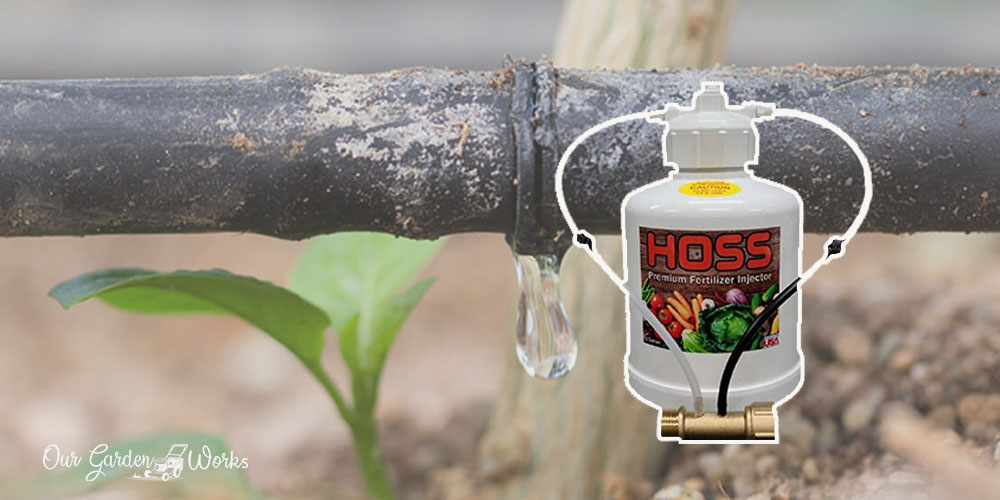
Wouldn’t it be nice if you could both feed and water your plants in one push or twist on the tap? Well, this is made possible by using the best fertilizer injectors for drip irrigation systems.
✅ Key Takeaways:
- The article discusses the best fertilizer injectors for drip irrigation systems, highlighting their benefits for gardening efficiency.
- It defines fertilizer injectors as tools that integrate fertilizers into existing irrigation setups based on water pressure and flow.
- The article reviews various models, including HOSS, NEWTRY, Chapin HydroFeed, and EZ-Flo, detailing their features, pros, and cons.
- It emphasizes that understanding water pressure and flow rate is crucial for effective operation of these injectors.
- Best practices for using fertilizer injectors include regular maintenance, using a backflow preventer, and controlling water pressure.
As a gardener, it can be intimidating to use new gardening tools, but an irrigation and feeding system is something that your future self will thank you for.
Watering and fertilizing garden plants are two of the most tedious tasks in gardening. Discover a timesaver and a lifesaver for your aching forearms and back when doing gardening chores without putting a hole in your pocket.
In this post, we will share with you the technology that most commercial farms and growers use to automate their gardening systems you can also do at home.
In A Hurry, Our Top Picks:
Fertilizer injector & its varieties
Before diving into the pool of plumbing parts, it pays to know the purpose of fertilizer injectors, how they work, and the types you can find in the market.
Not all fertilizer injectors are made equal. So, knowing what to look for based on your needs and the available water pressure in your area can save you a lot of trial and error.
A fertilizer injector is a tool that helps integrate liquid fertilizers or diluted granulated fertilizers into your existing irrigation systems, such as a hose, drip irrigation, or sprinkler system. It functions through water pressure and the water flow that pumps a specific amount of solution into the flowing water in the hose or pipes.
The fertilizer injector connects the water supply and the irrigation system or tools like hoses and sprinklers.
The total amount of released solution per gallon depends on the unit you will buy. However, the typical injector has a ratio of 1:20 which means it releases 1 gallon of fertilizer solution in every 20 gallons of water.
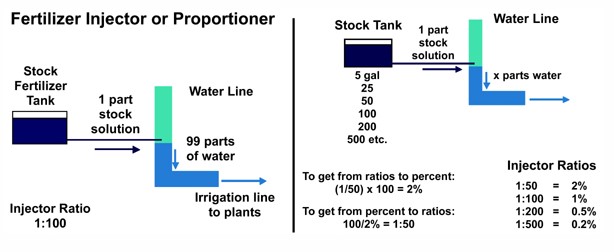
However, not all fertilizer injectors are made equal. Some have parts that are suitable for sprinkler systems, and some are ideal for drip irrigation systems.
The common problems that gardeners and farm owners encounter with fertilizer injectors are as follows:
- Thread size mismatch.
- The fertilizer solution is not pumped toward the irrigation system.
- The flow rediverts to the container due to insufficient water flow.
The conditions above usually occur when the fertilizer injector is connected to the irrigation system. With a few tweaks and plumbing part additions and adjustments, the system will work.
The rule of thumb in handling fertilizer injections is to ensure that the water flow is strong and continuous and the water pressure is strong enough to push the fertilizer out.
According to the University of Georgia, the most ideal water flow and pressure for a successful installation of a fertilizer injector depend on the size of your garden or farm operations.
We’ll discuss this later in this post. For now, check out the best fertilizer injectors for drip irrigation below.
6 Best fertilizer injectors for drip irrigation in the market [Top Picks for 2026]
There are tons of fertilizer injectors in the market, but the following brands stood out for their affordable price and efficiency. Some may need extra accessories due to the varying water pressure and operation size.
As long as you know how the fertilizer injection works, you can easily modify its parts to fit your needs.
Let’s start!
1. HOSS Fertilizer Injector 1 Gallon Tank
Pros:
- Works great for home gardens.
- Ideal for low water flow areas.
- Can be used for soaker hoses.
- Durable and easy to use.
- Time-efficient.
- Feed and water as fast as 10 minutes.
Cons:
- Has no backflow preventer.
- Pricey.
- Loses suction power if you have more than 50 psi water pressure.
- Not ideal for large-scale farming and gardening.
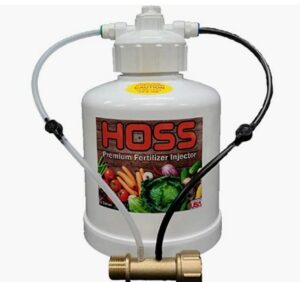
Out of all the fertilizer injectors in the market, HOSS is probably the most recommended by homeowners and small garden owners. It is ideal for gardens that are hand-watered or with overhead sprinklers and drip irrigation.
The whole kit comes with:
- PVC tank.
- Brass hose coupling.
- Tubes.
The brass hose coupling can handle a maximum water pressure of 50 psi. Its maximum pressure load is ideal for the low-pressure adjustment for drip irrigation systems. The tank has four settings that help you control the fertilizer application rates, which include:
- 1000:1.
- 500:1.
- 250:1.
- 100:1.
There are also control valves that will switch the fertilizer injection on and off. These valves are useful when you only need to water the plants and not be bothered detaching the fertilizer injection.
The manufacturer also advises users about some precautionary measures during installation and after use, such as:
- Avoid installing the brass coupling before a zone valve. This is to avoid pressure buildup and backflow.
- Clean the two connecting hoses before and after use to remove chemical residue.
- Keep the tank dry when it’s freezing outside.
Most gardeners prefer this fertilizer injector because it is among the most durable and has few issues when it comes to leaks and overall function. Gardeners also find great relief when using this injector because it allows them to water and feed their plants in as fast as 10 minutes with little to no effort.
Like most fertilizer injectors, some gardeners experience water pressure and backflow issues with this brand. The rule of thumb is to maintain flow and reduce water pressure to allow the fertilizer injection to suction efficiently.
If you have high water pressure in your region, it’s best to invest in a pressure regulator and backflow preventer when installing any fertilizer injector into your drip irrigation. Overall, this brand is worth a try, and you can see its quality yourself.
2. NEWTRY 0.4%-4% Fertilizer Injector for Drip Irrigation
Pros:
- Commercial-grade at an affordable rate.
- Reliable customer service.
- Functions well with a few adjustments.
- Comes with a lot of replacement parts.
- Ideal for a drip-irrigated yard with multiple stations.
Cons:
- May malfunction in high-water pressure areas.
- Faulty units.
- Requires pressure regulator and check valve to lower water pressure and avoid cases of broken seals, leaks, and backflow.
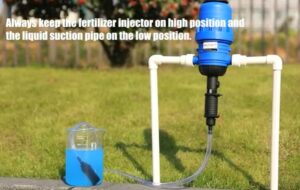
If you’re looking for something affordable and not fuzzy about the source location of the product, you should try NEWTRY Fertilizer injector. It has a pump-like design that mechanically injects small doses of fertilizer into your irrigation system.
Here are some of its technical features that you must check before installation:
- Percentage Range: 0.4 to 4%.
- Ratio Range: 1:250 to 1:25.
- Flow: 0.09 to 11 GPM.
- Pressure limit: 2.9 to 87 PSi.
- Connection Size: 3/4″ BST.
- Solution pH Level: 1-10.
Unlike the HOSS fertilizer injector, this brand claims it can handle water pressure of up to 87 PSi. It utilizes a tube with a filter end that is submerged in a bucket of solution. It uses the flow rate of water that passes through the main water line to suction the solution and pump small doses to the other end of the cylinder block that flows through the drip line.
The manufacturer claims that it can be used for:
- Animal facilities.
- Food safety & sanitation.
- Vehicle wash.
- Water treatment.
- Other dilution processing facilities.
NEWTRY fertilizer injector is versatile and can be used for any dilution processing system. In gardening, it’s more applicable for drip irrigation and impact sprinkler systems.
This brand has a lot of pros and cons and may only be worth the purchase if you’re willing to work around its few weaknesses and take advantage of its affordable price and commercial-grade results.
Here are some of the concerns about this brand and the creative ways users deal with it:
- The label is not accurate about the pipe threads. It is not in NPT and therefore will not fit your garden hose. It is actually in BSPT or British Pipe thread, so you’ll need to invest in 3/4″ pipe-to-hose thread adapters and the 3/4″ check valve to attach it to your irrigation system.
- The ratio adjustment is not a lever. Instead, you need to detach a latch that serves as a lock and rotate the cylinder block to adjust the ratio. Then, lock the latch back in.
- Some injector units can be squeaky and may require some lubricating oil for a quiet and smooth operation.
- The instructions are a bit hard to understand but the customer service is very efficient and would be willing to replace any defective unit or part.
- The pressure mentioned in the label is quite inaccurate. So, most users invest in a pressure regulator and keep it below 35 to 50 psi. It also helps prevent leakage on the seams.
NEWTRY fertilizer injector may not be perfect, but once you know its limits that are mentioned above, it can still function well. If you’re willing to make some adjustments and enjoy its affordable price, then this is the best brand for you.
3. Chapin HydroFeed 4701, 24-Ounce
Pros:
- Quiet and simple to use.
- Aesthetically designed tank.
- Comes with filters.
- Ideal for small and pocket gardens.
Cons:
- Fixed mixing rate.
- May require a pressure regulator for areas with high water pressure.
- May require multiple refills when handling a bigger yard.
- May leak when the gaskets are not properly placed.
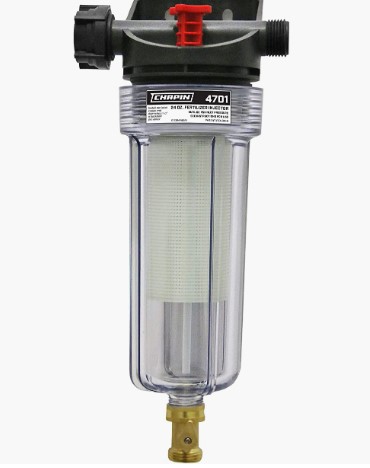
Chapin HydroFeed is a reliable fertilizer injector for small and pocket gardens. It is a 24 oz. clear tank aesthetically designed with a funnel-shaped structure to easily monitor fertilizer usage.
Aside from its transparent tank, it comes with filters and tight seals to prevent leaks and other types of malfunctions.
Here are some of its features:
- Clear 24-ounce or 0.25-gallon funnel-shaped tank.
- Built-in bracket for mounting.
- Filtered inlet tube to strain debris from liquid and fish fertilizers.
- Brass drain plug with valve for quick tank drain.
Chapin fertilizer injector fits perfectly on garden hoses, drip irrigation hose bibs, and sprinkler systems. It efficiently works with low-water pressure rated at 40 PSi. However, it only functions at a specific ratio which is 1:128. Approximately it has a minimum flow rate of 1 GPM.
Therefore, this brand is only ideal for small irrigation operation that feeds and waters the plants in as fast as 3 to 5 minutes. Otherwise, you’ll need to refill the tank multiple times for bigger yards.
If you want to start small and grow plants that are not fuzzy with fertilizers, this HydroFeed may perfectly suit your needs. It’s quiet and gets the feeding and watering done in just a few minutes.
4. Yardwe 3/4 Inch Fertilizer Injector for Drip Irrigation
Pros:
- Affordable and versatile.
- Threaded joints are resistant to acid and alkali.
- Filtered inlet.
- The inlet can be dipped in a barrel or a big pail of fertilizer concentrate or solution.
- Ideal for large-scale operations with a few pipe modifications.
Cons:
- Misleading pipe thread information and won’t fit on the typical garden hose.
- May struggle with suction power without an adequate flow rate and low water pressure.
- Requires pipe adapter, check valve, and pressure regulator for smooth operation.
- May require basic technical knowledge in extending flow rate or adjusting pipe size to make it work as desired.
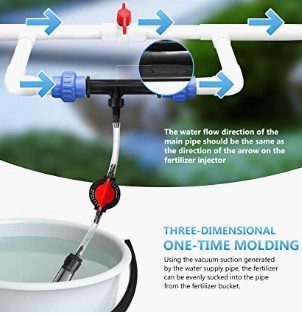
Big gardens require many gallons of plant food. If a gallon of fertilizer is not enough, you may use a flexible fertilizer injector like Yardwe. It is a kit that comes with an injector and valves to control the mixing rate.
Here’s what you can expect from the kit:
- Transparent inlet outlet pipes.
- Control valve with 4 gears.
- Filtered inlet.
The manufacturer takes pride in the threaded joints that are heavily resistant to acid and alkali common to tap water and fertilizers. Yardwe fertilizer injection is ideal for large-scale drip irrigation and sprinkler systems.
Like other fertilizer injector brands, it is very sensitive to high water pressure and requires a good flow rate to trigger the suction. The only caveat of this brand is it is unfit for NPT (National Pipe Thread) or GHT(Garden Hose Thread) threads. It has BSPT ends, therefore your typical garden hose will not fit.
You’ll need to invest in pipe thread adapters and pressure regulators to have control over its suction power. Since it can’t handle too much pressure, you may increase the pipe size that extends to your drip system or extend the operation coverage to improve the flow rate.
5. EZ-Flo 2.5 Gallon Main-line Dispensing System – Standard Capacity Fertilizer Injector
Pros:
- Complete parts with additional Flo-Discs for drip irrigation systems.
- Easy to use.
- Quiet operation.
- Flexible to any type of irrigation system.
- Ideal for low-water pressure areas.
- Ideal for small to medium-scale gardens and farms.
- Complete product information and guide.
- Accurate part descriptions on labels.
- Fits in NPT or garden hose threads.
- No need for pipe adapters.
Cons:
- Pricey.
- Susceptible to damage when water pressure is not monitored.
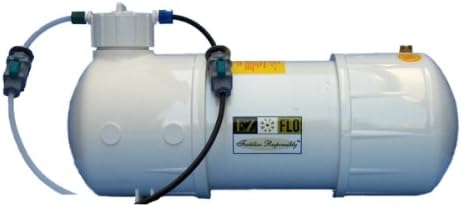
EZ-Flo is another gardener favorite for its complete set of materials that allows it to be versatile for any type of irrigation. It has the same structure as HOSS fertilizer injection.
However, it is ideal for several types of irrigation systems and can be adjusted for drip irrigation by adding a tiny disc inside the tank. According to the manufacturer, it is ideal for:
- Backyard gardens.
- Commercial landscapes.
- Small-scale garden centers.
The whole fertilizer injection system functions best when the water is at 50 PSi and below.
If you have high water pressure, you’ll need to invest in a pressure regulator and backflow preventer to ensure its smooth operation. The fertilizer injection kit includes:
- Polyethylene (PE) tank.
- Cap with pick-up and agitation dip tubes.
- Hose bibb adapter which connects directly to an outdoor faucet (preferably with a backflow preventer).
- The inlet/outlet bypass tubing (1 black, 1 clear).
- 2 barbed on/off valves.
- Set of Flow Discs for low-flow applications for drip irrigation.
EZ-FLO fertilizer injector requires a minimum flow rate of 120 GPH for sprinklers and hose irrigation systems. For drip irrigation, the minimum flow rate can be as low as 7.5 GPH with the help of installed Flo-Discs.
EZ-Flo is also one of the few companies with an elaborate set of instructions and precautions for using their fertilizer injectors. Some of these include:
- You must release the pressure from the tank when not in use. In drip irrigation, the pressure will naturally pass through the drip emitters. In sprinkler and hose systems, you’ll need to remove the cap or tubing to release the pressure.
- The manufacturer advises all garden owners to use a backflow preventer when using the product to ensure the safety of their potable water.
- Hose-threaded EZ-FLO injectors must be placed in line with valves or timers because they can’t handle constant pressure for a long time. Otherwise, the tank may burst or leakage may occur.
- The water pressure should be controlled within 50 PSi or less or the tank may rupture.
- Constant exposure of the PVC tank to the elements and high water pressure can weaken the plastic and make it more susceptible to bursting. Place the fertilizer injector where it is safe from the elements to preserve or lengthen its lifespan.
During winter, remove the fertilizer injectors from the irrigation system and prepare them for storage. Drain, clean, and store them in the garage to protect them from freezing temperatures outdoors.
EZ-Flo is easily one of the best brands that you can try especially if you use several types of irrigation systems. Before investing in this fertilizer injector, ensure that you are aware of the practices that can damage the tank since it is the most susceptible part to leakage and bursting.
6. Chapin 4710 HydroFeed 1-Gallon in-Line Auto-Mix Fertilizer Injector
Pros:
- Ideal for large-scale drip systems.
- Has a bigger capacity and mix ratio.
- No need for pipe adapters.
- Accurate part description in labels.
Cons:
- Some parts are a bit flimsy.
- The pressure and flow rate must be monitored and kept at a minimum.
- Pricey.
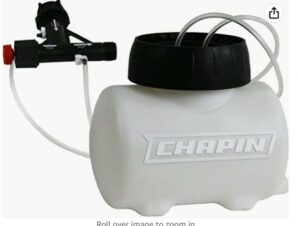
Chapin HydroFeed is the most suitable option for large-scale drip irrigation systems. It is a fertilizer injector with a 10-gallon tank that can mix 1oz to 10oz. of fertilizer to the water line. Like most fertilizer injectors, it can only handle around 40 to 60 PSi for optimal function but its minimum flow rate is at 2 GPM (gallon per minute).
Most gardeners appreciate this fertilizer injector because it has a bigger capacity and is more flexible in releasing a bigger volume of fertilizer into the irrigation line.
The tank is also translucent which makes monitoring easy. It fits the standard hose fittings like NPT, so you no longer need to invest in pipe adapters.
The injector has a filtered inlet that helps prevent clogging and a drain with valves to help get rid of any residue in the tank and tubes.
You must keep everything under its required water pressure and flow rate to ensure optimal operation. Otherwise, it will have weak suction power that will not be enough to draw the fertilizer off the tank.
If this fertilizer injector is installed correctly and operated properly, it can be one of the best investments in small-scale garden centers. It reduces feeding time, labor, and energy from owners and gives them more time on important business tasks.
The only problem that most gardeners encounter is the lack of suction power and broken seams in the tank which can be prevented by using a pressure regulator and improving the flow rate.
Additional parts or accessories to add for your fertilizer injection
Drip irrigation and fertilizer injectors are not powered by any source of energy. Instead, they heavily rely on fluid dynamics.
The rule of thumb is to increase the flow rate to increase the suction power of the injector and sustain the continuous movement of water with less water pressure.
Due to varying water pressure in every state of the region in the US, here are some additional attachments that you’ll need aside from the fertilizer injector.
What to keep in mind in using fertilizer injections in drip irrigation
According to the University of Georgia, you should consider several factors when buying and using a fertilizer injector.
These factors will help you find the right kind of fertilizer injector and control the maximum time needed to deliver the hydration and plant food that they need.
Any mishaps in the flow rate, mix ratio, and operation time can cause costly damage to crops and plants in a garden center due to potential under-fertilization, drought, or fertilizer burns. Observe these factors when installing either your drip irrigation system or fertilizer injector.
Size of the operation/amount of ground to be fertilized and irrigated
Not all fertilizer injectors are the same. There are small units for home use and those that are more equipped for industrial use. The different kinds of fertilizer injectors are as follows:
- Venturi-type injectors (HOSS, NEWTRY, CHAPIN, EZ-Flo).
- Positive-displacement injectors (YARDWE, GEWA, Dosatron).
- EC and PH controllers.
Flow rate
The flow rate is closely related to the size of the operation. This means it includes how many drippers, sprinklers, or hose ends are connected to the irrigation system.
Amount of fertilizer for each plant or square foot of plant bed
The mix ratio of fertilizers depends on the kind of plants that you grow. Some are heavy feeders while some need specific types of nutrients. The nutrient needs of your plants must match the mix ratio available in the fertilizer injector. Otherwise, you’ll risk overfeeding your plants.
The time needed to deliver the fertilizer
Drip irrigations usually take around 3 to 10 minutes to water and feed medium-sized gardens. However, as the operation coverage expands, so does the operating time.
Water pressure
Varying water pressure in rural areas and cities can affect the suction power of fertilizer injectors. Some units are more flexible to high water pressure while some need below 40 to 50 PSi.
Best practices in handling fertilizers using fertilizer injectors
- Strain fish emulsion and powdered fertilizers to prevent clogging up the tubes.
- Too much water pressure will not draw fertilizer from the tank. Use a pressure regulator before the fertilizer injector.
- Remove excess pressure on the tank before and after use.
- Check the gaskets from time to time and replace them when needed to avoid leakage.
- It is better safe than sorry. So, make sure to use a backflow preventer to prevent possible water line contamination, especially when handling insecticides and other harmful chemicals.
Final Thoughts
We hope that this post helped have a brief idea about the best fertilizer injectors in the market and how they work. It may seem intimidating at first since some parts are very technical but focus on water pressure and flow rate and you’ll easily catch on.
Let us know in the comments how these fertilizer injectors changed the game in your garden.
With new garden technologies on the rise, gardeners are more equipped with tools to achieve a more sustainable lifestyle without too much labor and an abundance of time.
Also, please share this with your friends and let them learn more about this small equipment and how it can elevate your garden management strategy.
For the complete soil and lawn health framework, our garden soil guide covers testing, amending, fertilizing, and maintaining for every situation.

1 thought on “6 Best Fertilizer Injectors For Drip Irrigation System (Top Picks in 2026)”