

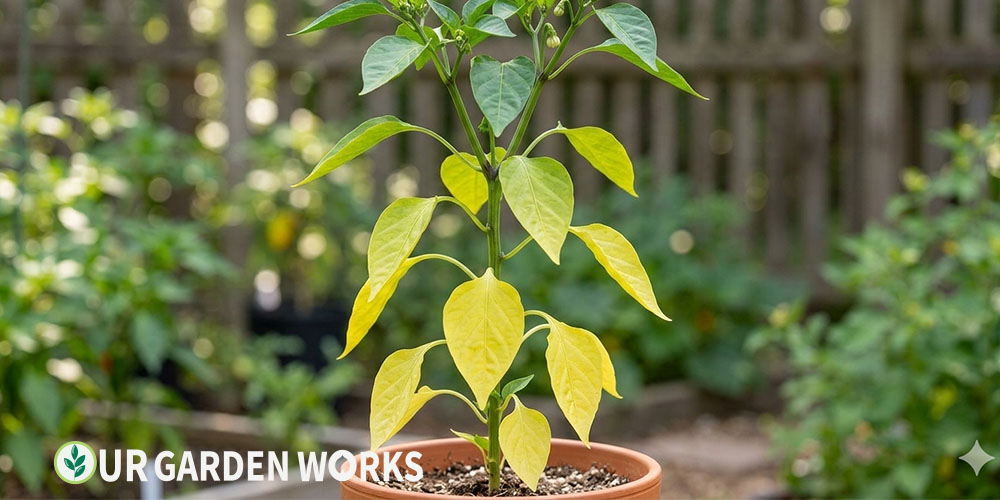
Yellow leaves on pepper plants generally trace back to one of a small handful of causes, and the position of the yellowing on the plant — lower versus upper, scattered versus uniform — tells you a great deal before you even check the soil.
Peppers tend to show stress more visibly and more quickly than some other vegetables, which actually works in your favor for diagnosis.
We’ll walk through the six most common causes, organized so you can match the pattern you’re seeing to the likely culprit. Most cases resolve within a couple of weeks once the right adjustment is made.
Quick Answer: Yellow leaves on pepper plants are most often caused by nitrogen deficiency (uniform yellowing, lower leaves first), overwatering (yellow with soft texture), underwatering (yellow with crispy edges), transplant shock (temporary, after a recent move), magnesium deficiency (yellow between veins, older leaves), or cold stress (yellowing after a cold night). Check the pattern and recent conditions to narrow it down.
Cause 1 — Nitrogen Deficiency
Nitrogen deficiency produces uniform yellowing that starts on the oldest, lowest leaves first, since the plant redirects available nitrogen to support new growth at the expense of established foliage.
This is one of the most common causes of pepper yellowing, especially in soil that hasn’t been fertilized recently or that’s naturally low in organic matter.
How to confirm it’s nitrogen deficiency:
- Yellowing is uniform across the whole leaf, not patterned between veins
- Lower, older leaves affected first and most severely
- Overall plant growth seems slow compared to expectations
- No recent fertilizing, or a long gap since the last application
Fix: Apply a balanced or slightly nitrogen-forward fertilizer, following label rates. Once flowering begins, switch to a lower-nitrogen, higher-potassium formula to avoid pushing excessive leafy growth at the expense of fruit production — see our guide to growing peppers in containers for the full fertilizing progression through the season.
Cause 2 — Overwatering
Overwatered peppers show yellowing leaves that often feel slightly soft or limp, accompanied by consistently wet soil that never gets a chance to dry between waterings.
Pepper roots are particularly sensitive to waterlogged conditions and decline quickly when oxygen is unavailable in saturated soil.
How to confirm it’s overwatering:
- Soil is consistently wet to the touch
- Yellowing leaves feel soft rather than crispy
- Poor drainage is visible in the container or planting site
- Symptoms don’t improve, or worsen, with more frequent watering
Fix: Allow soil to dry out somewhat between waterings — peppers actually tolerate and benefit from slight dry-down better than many vegetables. Check that containers have adequate drainage holes and that in-ground beds aren’t holding standing water after rain.
Cause 3 — Underwatering
On the opposite end, underwatered peppers show yellowing combined with crispy, dry leaf edges and an overall wilted appearance, especially noticeable during the heat of the day. While peppers tolerate some drought better than tomatoes, sustained dry conditions still produce visible stress.
How to confirm it’s underwatering:
- Soil feels dry several inches down
- Yellowing is accompanied by crispy, brittle leaf edges
- Plant wilts visibly during peak heat, sometimes recovering partially overnight
Fix: Establish a consistent watering schedule, checking soil moisture every 2-3 days rather than waiting for visible wilting. Mulching around the base helps retain soil moisture between waterings significantly.
Cause 4 — Transplant Shock
Peppers transplanted recently, whether from a nursery pot or moved within the garden, often show temporary yellowing as the root system adjusts to its new environment.
This is a normal stress response rather than a sign of an ongoing care problem, and it typically resolves on its own within a couple of weeks.
How to confirm it’s transplant shock:
- Yellowing began shortly after transplanting
- No other clear signs of watering or nutrient problems
- New growth, as it appears, looks healthy and green
Fix: Patience and consistent care. Avoid fertilizing heavily during this adjustment period, and ensure the plant isn’t also dealing with temperature stress (covered below) on top of the transplant itself.
Cause 5 — Magnesium Deficiency
Magnesium deficiency produces a distinctive pattern — yellowing between the leaf veins while the veins themselves stay green, similar in appearance to the iron chlorosis pattern seen in other plants but caused by a different nutrient.
This typically shows up on older leaves first and is more common in sandy soils or after heavy rain has leached nutrients from the root zone.
How to confirm it’s magnesium deficiency:
- Yellowing appears between veins while veins remain green
- Older leaves affected first
- Sandy soil or recent heavy rainfall in the garden’s history
Fix: A diluted Epsom salt solution (magnesium sulfate) applied as a soil drench or foliar spray addresses this specific deficiency quickly, often showing improvement within a week or two.
Cause 6 — Cold Stress
Pepper plants are notably cold-sensitive, and exposure to temperatures below about 55°F, even briefly overnight, can trigger yellowing and stunted growth that appears over the following days.
This is especially common with peppers transplanted slightly too early in spring, before nighttime temperatures have reliably warmed.
How to confirm it’s cold stress:
- Yellowing followed a recent cold night or unexpected temperature drop
- Plant was transplanted relatively early in the season
- Growth has generally slowed or stalled since the cold exposure
Fix: Protect plants with row covers or cloches during any forecasted cold nights going forward. Established plants usually recover as consistently warm weather returns, though severely stressed transplants may take several weeks to resume normal growth.
Telling the Six Causes Apart at a Glance
| Cause | Pattern | Key Clue |
|---|---|---|
| Nitrogen deficiency | Uniform, lower leaves first | No recent fertilizing |
| Overwatering | Yellow + soft texture | Soil consistently wet |
| Underwatering | Yellow + crispy edges | Soil dry, plant wilts in heat |
| Transplant shock | Temporary, after a move | Recent transplanting |
| Magnesium deficiency | Yellow between green veins | Sandy soil, heavy rain history |
| Cold stress | Follows a cold night | Early-season transplant |
Why Peppers Show Yellowing Differently Than Tomatoes
If you grow both peppers and tomatoes, you may notice peppers seem to react faster and more visibly to stress than their nightshade relatives.
Peppers have a comparatively smaller root system relative to their above-ground growth, which means problems with watering or nutrition translate into visible leaf symptoms more quickly than the same issue would in a tomato plant.
This faster feedback loop is actually useful for diagnosis, since pepper yellowing tends to appear and respond to corrections within a shorter window than equivalent tomato problems.
If you’ve adjusted watering or fertilizing and don’t see any improvement within a week or two, it’s a reasonable signal to reconsider your diagnosis rather than waiting much longer for change.
How Pot Size and Soil Volume Influence Yellowing Risk
Container-grown peppers face a compounding risk that in-ground plants don’t, since a too-small pot limits root development at the same time it limits the soil volume available to buffer against watering or nutrient mistakes.
A pepper plant crowded into a pot that’s too small for its size shows yellowing more readily and more severely than the same variety with adequate root room, even when watering and feeding are otherwise identical.
This is part of why container pepper guides consistently recommend generous minimum pot sizes rather than the smallest container a plant will technically fit in.
If yellowing has been a recurring problem with a container pepper specifically, checking whether the plant has become rootbound — roots visibly circling the inside of the pot or emerging from drainage holes — is worth doing before assuming the cause is purely about water or nutrients.
Seasonal Patterns in Pepper Leaf Yellowing
Recognizing that certain causes cluster at certain points in the growing season helps narrow the diagnosis even further.
Cold stress and transplant shock are almost exclusively early-season problems, showing up in the weeks just after plants go into the garden, while nitrogen deficiency tends to develop somewhat later as the plant’s initial fertilizer charge gets used up over several weeks of active growth.
Magnesium deficiency often becomes more apparent in mid-to-late summer, particularly following a stretch of heavy rain that can leach nutrients from soil, while overwatering and underwatering can occur at any point but tend to spike during unusually wet or unusually hot, dry stretches respectively.
Keeping rough track of when yellowing appeared relative to your planting date and recent weather adds another useful data point to the diagnosis process.
Frequently Asked Questions
Will yellow leaves on my pepper plant affect fruit production?
It depends on severity and cause. Mild yellowing limited to a few lower leaves rarely affects fruiting, but widespread yellowing from nutrient deficiency or significant water stress can reduce both flower set and fruit size, since the plant has less healthy leaf surface to support fruit development through photosynthesis.
Should I remove yellow leaves from my pepper plant?
Removing severely yellowed or dying leaves is reasonable for tidiness and to redirect the plant’s energy, but there’s no urgent need to remove mildly yellowing leaves that are still attached and functioning.
Focus on correcting the underlying cause first — removing leaves doesn’t address whatever produced the yellowing in the first place.
Can container-grown peppers get yellow leaves for different reasons than in-ground plants?
The same six causes apply to both, but containers tend to swing toward nitrogen deficiency and inconsistent watering more often, since potting mix holds fewer nutrient reserves and dries out faster than garden soil.
Container peppers typically need more frequent fertilizing and more attentive watering than the same variety grown directly in well-amended ground.
Related Articles in Our Pepper Leaf Problems Guide
- Yellow Leaves on Pepper Plants — Why It Happens
- Holes in Pepper Leaves — Diagnosis Guide
- Brown Spots on Pepper Leaves — Causes and Fixes
- Why Are Pepper Leaves Curling? 6 Causes and How to Fix Each One
- How to Grow Peppers (Bell & Hot) — Complete Guide
- 6 Best Companion Plants for Peppers – Full List (2026)
- Growing Peppers in Containers: Varieties, Pots & Fertilizing (2026)
Final Thoughts
We hope this guide has helped you match the pattern on your pepper plant to the right cause — most cases of yellowing are straightforward to fix once correctly identified.
For all our pepper and vegetable growing guides, our vegetable gardening guide links to everything.
Share this post with a fellow gardener who’s troubleshooting their pepper plants — and let us know in the comments which cause matched what you found. Happy growing!
