

Blueberries are more particular about soil chemistry than almost any other fruit you’ll grow at home, and yellow leaves are usually the plant’s most direct way of telling you that something about that chemistry is off.
The good news is that one cause explains the vast majority of cases, and it’s both easy to confirm and straightforward to fix.
We’ll walk through that primary cause first, then cover the less common explanations worth ruling out if soil pH doesn’t turn out to be the answer.
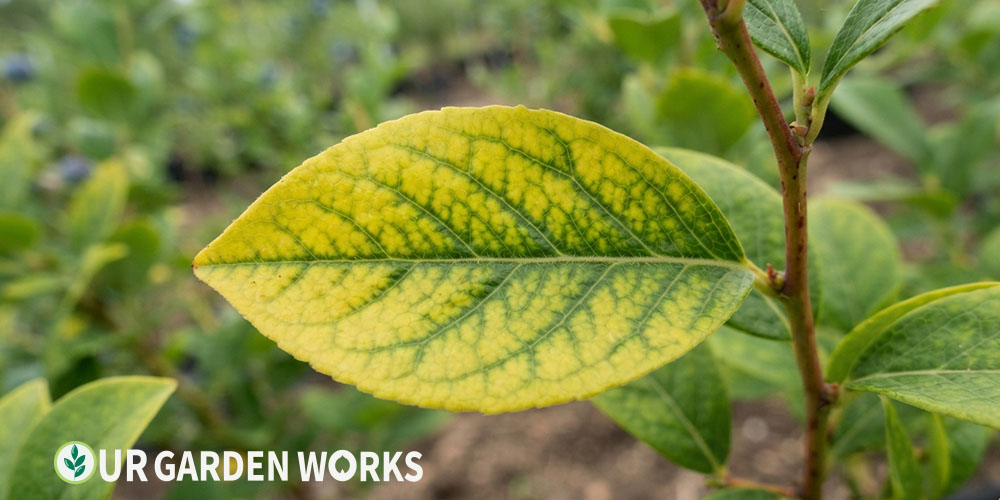
Quick Answer: Yellow leaves on blueberry bushes are most often caused by soil pH that’s too high (blueberries need acidic soil, 4.5-5.5), which triggers iron chlorosis — yellow leaf tissue with green veins. Other causes include nitrogen deficiency, overwatering, and natural fall color change. Test your soil pH first, since this single factor explains the large majority of cases.
Cause 1 — Soil pH Too High (Iron Chlorosis)
Blueberries need genuinely acidic soil, ideally in the 4.5 to 5.5 pH range, which is considerably more acidic than most garden soil and most other fruiting plants require.
When soil pH rises above this range, even slightly, iron becomes chemically locked up and unavailable to the plant’s roots regardless of how much iron is actually present in the soil.
The result is the same green-veined yellowing pattern called iron chlorosis that shows up in other acid-loving plants under the same condition — yellow leaf tissue with the veins themselves remaining distinctly green, creating a netted appearance across the leaf.
How to confirm it’s pH-related iron chlorosis:
- Veins remain green while tissue between them turns yellow
- New growth typically shows symptoms first, most severely
- Soil test shows pH above 5.5, often well above it
- Plant is growing in unamended garden soil rather than soil specifically prepared for acid-loving plants
Fix: Lower soil pH with elemental sulfur, worked into the soil around the root zone according to package rates based on your current pH and soil type. This is a gradual process taking several months to a year to fully shift pH, so a chelated iron supplement provides faster, more immediate relief for the current season’s foliage while the longer-term pH correction takes effect.
💡 Test pH before adding any sulfur
Adding sulfur without first confirming your actual soil pH risks over-correcting and creating new problems if your soil happens to already be acidic enough.
A simple home soil pH test, available inexpensively at any garden center, removes this guesswork and tells you exactly how much adjustment, if any, is actually needed.
Cause 2 — Nitrogen Deficiency
Blueberries are relatively light feeders compared to many garden plants, but they still need adequate nitrogen, and a true deficiency produces a more uniform yellowing across the whole leaf, including the veins, rather than the green-vein pattern of iron chlorosis. This typically shows up on older, lower leaves first.
How to confirm it’s nitrogen deficiency:
- Yellowing is uniform across the leaf, veins included
- Older, lower leaves affected first
- Soil pH tests within the appropriate acidic range, ruling out chlorosis
- Overall plant growth and vigor seem reduced
Fix: Apply a fertilizer formulated specifically for acid-loving plants (often labeled for azaleas, rhododendrons, or blueberries specifically), which provides nitrogen in a form that won’t push soil pH in the wrong direction the way some general-purpose fertilizers can.
Cause 3 — Overwatering or Poor Drainage
Blueberries have shallow, fibrous root systems that are notably sensitive to waterlogged conditions, and saturated soil impairs root function enough to produce yellowing even when soil moisture is technically abundant.
This is a different mechanism than nutrient deficiency but can produce visually similar uniform yellowing.
How to confirm it’s overwatering:
- Soil is consistently wet or the planting site has poor drainage
- Yellowing may be accompanied by a slightly wilted or weak appearance
- Symptoms don’t improve, or worsen, despite watering more
Fix: Reduce watering frequency and improve drainage if the planting site is prone to standing water. Raised beds or mounded planting areas help considerably in heavier soils that drain slowly.
Cause 4 — Natural Fall Color Change
As blueberry bushes move toward dormancy in fall, it’s completely normal for leaves to turn yellow, orange, or red as part of the plant’s natural seasonal cycle, often putting on a genuinely attractive display before leaf drop. This requires no concern or intervention at all.
How to confirm it’s seasonal:
- Timing coincides with fall, as the growing season winds down
- Color change is often more vibrant (orange/red tones) rather than the flatter yellow of chlorosis
- Plant has had a normal, healthy growing season up to this point
Fix: None needed — enjoy the fall color display.
Telling the Four Causes Apart at a Glance
| Cause | Pattern | Soil pH | Timing |
|---|---|---|---|
| Iron chlorosis (high pH) | Yellow with green veins | Above 5.5 | Growing season, new growth first |
| Nitrogen deficiency | Uniform, older leaves first | Normal range | Growing season |
| Overwatering | Uniform, weak appearance | Variable | Growing season, wet soil |
| Natural fall change | Vibrant yellow/orange/red | N/A | Fall, whole plant |
Preparing Soil Correctly Before Planting
Since soil pH explains the majority of blueberry yellowing cases, getting this right before you ever plant prevents years of ongoing correction efforts.
Testing and amending soil to the appropriate acidic range months before planting, rather than trying to retrofit an already-planted bush’s soil chemistry, produces far more reliable long-term results.
Incorporating peat moss, sulfur, or other acidifying amendments thoroughly into the planting area, rather than just the immediate planting hole, gives roots room to expand into appropriately acidic soil as the bush matures over several years.
Many successful blueberry growers also mulch with pine needles or pine bark specifically, since these naturally acidic materials provide ongoing, gradual reinforcement of the soil’s pH as they break down over time.
Container-Grown Blueberries and pH Management
Growing blueberries in containers, often using a mix specifically formulated for acid-loving plants, gives you considerably more direct control over soil pH than managing a large in-ground planting area, which is part of why containers are such a popular solution for gardeners with naturally alkaline native soil.
The smaller, contained soil volume also means pH corrections take effect faster than in an equivalent in-ground bed, since there’s simply less total soil mass to amend.
The tradeoff is that container soil pH can also drift more quickly in the wrong direction if watered with alkaline tap water consistently over time, since there’s less soil volume to buffer against that gradual shift.
Testing container blueberry soil pH at least once or twice during the growing season, rather than relying on a single annual check as might suffice for an established in-ground planting, helps catch and correct this drift before it produces visible chlorosis.
Using rainwater or filtered water for container blueberries, rather than straight tap water in regions with notably alkaline or hard water, reduces how often active pH correction is needed in the first place.
This is a similar principle to the water quality considerations covered in our peace lily care guide, where sensitive plants benefit from a cleaner water source regardless of the specific reason for that sensitivity.
How Often Should You Test and Adjust Soil pH?
Soil pH doesn’t stay fixed once adjusted — it gradually drifts back toward its natural baseline over time, particularly in regions with naturally alkaline soil or where irrigation water itself is alkaline.
An annual pH test, ideally in early spring before the growing season ramps up, catches drift before it produces visible chlorosis symptoms.
If your test shows pH creeping upward year over year despite previous sulfur applications, this is useful information that your specific soil and water conditions require more consistent, ongoing acidification rather than a one-time correction.
Building this annual check into your regular garden routine, alongside other seasonal tasks, prevents the cycle of waiting for yellow leaves to appear before addressing what’s really an underlying, recurring soil chemistry issue.
Frequently Asked Questions
Will yellow leaves on my blueberry bush affect this year's berry harvest?
Mild, early-caught chlorosis often has limited impact on the current season’s fruit, but significant, sustained yellowing reduces the plant’s overall photosynthetic capacity and can noticeably reduce both berry size and yield.
Catching and correcting the underlying soil pH issue promptly protects both this season’s harvest and the plant’s longer-term productivity.
How long does it take to see improvement after correcting soil pH?
A chelated iron supplement often shows visible improvement in new growth within 1-2 weeks, since it provides iron in an immediately available form.
The underlying sulfur-based pH correction works much more slowly, typically taking several months to a year to meaningfully shift soil chemistry, which is why combining both approaches gives faster results than relying on pH adjustment alone.
Can I grow blueberries successfully if my native soil is naturally alkaline?
Yes, though it requires more deliberate, ongoing soil management than growing blueberries in naturally acidic soil.
Many gardeners in alkaline-soil regions grow blueberries successfully in raised beds or large containers filled with a properly acidified soil mix, which is easier to control and maintain than trying to continuously correct a large area of native alkaline ground.
Do all blueberry varieties have the same soil pH requirements?
Most common blueberry types — highbush, lowbush, and rabbiteye varieties — share similar acidic soil preferences in the 4.5 to 5.5 range, though rabbiteye varieties are sometimes slightly more tolerant of marginally higher pH than highbush types.
Regardless of variety, none of the common blueberry types tolerate neutral or alkaline soil well, making pH management a near-universal requirement for successful blueberry growing.
Related Articles in Our Gardening Guide
- Yellow Leaves on Hydrangeas – 7 Causes + Fixes
- (Free tool) Soil pH Calculator — How Much Lime or Sulfur to Add
- How to Prepare Garden Beds for Spring (8 Steps)
- How to Grow Green Beans: Bush and Pole Varieties Compared (2026)
- Vegetable Gardening Guide
- Garden Soil Guide: Fix Your Soil, Grow Better Plants
Final Thoughts
We hope this guide has made the connection between soil chemistry and your blueberry bush’s yellow leaves much clearer — and given you a reliable path to fixing it through proper pH management.
Testing your soil before assuming any other cause is almost always the right first move with this particular plant.
Share this post with a fellow gardener who’s troubleshooting their blueberry bushes — and let us know in the comments what your soil test revealed. Happy growing!
