

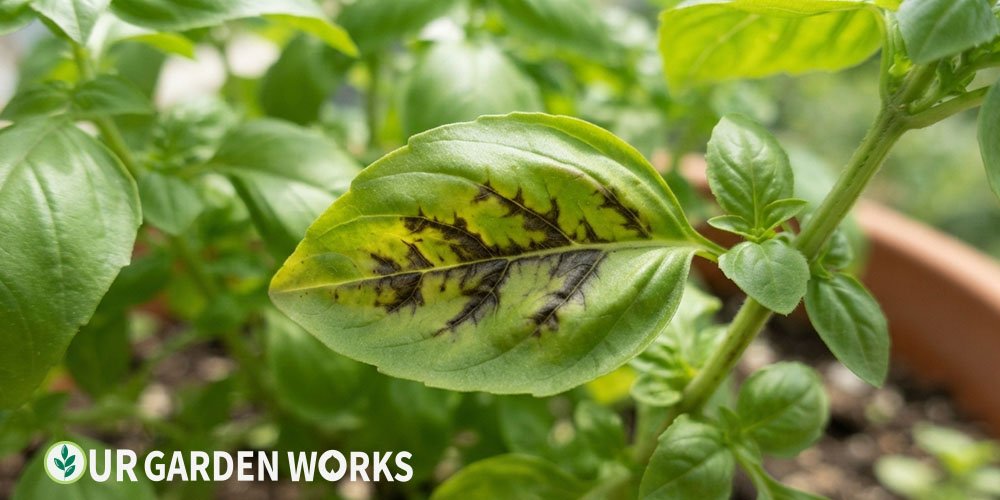
Basil is one of the more disease-prone common kitchen herbs, and brown spots are unfortunately a familiar sight for many home growers at some point in the season.
The good news is that the most common culprit, downy mildew, has become well understood enough that resistant varieties now make a real difference if this has been a recurring frustration.
We’ll walk through the leading causes, with the visual details that separate one from another, since basil’s specific diseases have some distinctive features worth knowing.
Quick Answer: Brown spots on basil leaves are most often downy mildew (angular brown to black spots following leaf veins, grayish fuzz on the underside), bacterial leaf spot (smaller, water-soaked spots, often with a yellow halo), or simple sunscald (irregular bleached patches with no defined pattern). Check the leaf underside for fuzzy gray growth first, since this confirms downy mildew, the most common cause by far.
Cause 1 — Downy Mildew (Most Common, Most Distinctive)
Basil downy mildew has become an increasingly significant problem for home and commercial growers alike over the past couple of decades, and it produces a genuinely distinctive symptom pattern once you know to check the right spot.
On the upper leaf surface, you’ll see angular, brown to black or yellowish spots that tend to follow the leaf’s vein pattern rather than appearing as random round spots.
The truly defining confirmation, though, is on the underside of the leaf directly beneath those spots — a grayish, fuzzy fungal growth that’s often most visible when you tilt the leaf toward good light.
This downy fuzz is what gives the disease its name and distinguishes it clearly from the other causes on this list.
How to confirm it’s downy mildew:
- Spots are angular and tend to follow the leaf’s vein pattern rather than forming round circles
- Grayish, fuzzy growth visible on the leaf underside, directly beneath the spots
- Worse in humid conditions and can spread rapidly once established
- Often affects multiple plants in the same growing area simultaneously
Fix: Unfortunately, there’s no truly effective cure once downy mildew is established — remove and dispose of affected leaves and plants promptly to slow spread. Improve airflow, switch to soil-level watering, and space plants more generously for any future plantings.
Choosing downy mildew-resistant basil varieties, now widely available from several seed companies specifically bred for this resistance, is the single most effective long-term solution if this disease has been a recurring problem.
💡 Resistant varieties have changed the basil-growing game
Basil downy mildew became enough of a widespread problem in commercial and home growing that breeders responded with several genuinely resistant cultivars, often labeled clearly as downy mildew resistant on seed packets.
If you’ve struggled with this disease for multiple seasons, switching varieties is likely to solve the problem more completely than any treatment applied after infection.
Cause 2 — Bacterial Leaf Spot
Bacterial leaf spot produces smaller, more discrete spots than downy mildew’s angular, vein-following pattern, often with a water-soaked or slightly greasy appearance and sometimes a yellow halo surrounding individual spots.
It lacks the fuzzy underside growth that confirms downy mildew, relying instead on its watery texture and lack of vein-pattern angularity for identification.
How to confirm it’s bacterial leaf spot:
- Spots are smaller and more rounded, without following the vein pattern
- Water-soaked, slightly greasy texture rather than dry and angular
- No fuzzy gray growth on leaf undersides
- Spreads readily after rain or overhead watering
Fix: Remove affected leaves, switch to soil-level watering, and avoid working among wet plants to reduce hand and tool transmission. A copper-based bactericide can help manage more significant outbreaks, though prevention through proper watering remains the more reliable long-term approach.
Cause 3 — Sunscald
Sunscald produces irregular, bleached to brown patches with no defined border or vein-following pattern, typically following a sudden increase in direct sun exposure that the plant hasn’t yet acclimated to.
This is a physiological response rather than a disease and requires no treatment beyond preventing future occurrences.
How to confirm it’s sunscald:
- Damage correlates with a recent change in sun exposure rather than humid weather
- Patches are irregular and bleached-looking, without the angular vein-pattern of downy mildew or the water-soaked texture of bacterial spot
- No fuzzy growth or spreading to unaffected leaves
Fix: No treatment reverses existing scald damage. Acclimate basil gradually to increased sun exposure when moving plants from indoor or shaded conditions to a sunnier spot, over several days rather than all at once.
Telling the Three Causes Apart at a Glance
| Cause | Spot Pattern | Underside Growth | Texture |
|---|---|---|---|
| Downy mildew | Angular, follows veins | Gray fuzz | Dry |
| Bacterial leaf spot | Small, round | None | Water-soaked, greasy |
| Sunscald | Irregular, no pattern | None | Bleached, papery |
Why Basil Is Particularly Vulnerable to Downy Mildew
Basil’s susceptibility to downy mildew specifically, more so than many other common kitchen herbs, has to do partly with the dense, often closely spaced way basil is traditionally grown — whether in a kitchen garden bed, a windowsill pot, or commercial production — which creates exactly the humid, still-air microclimate the pathogen favors.
The disease’s relatively recent emergence as a major problem (it became significantly more widespread starting in the early 2000s in many growing regions) also means many older, traditional basil varieties simply weren’t bred with any resistance to it at all.
This combination of growing habit and variety vulnerability is why the prevention strategies for basil specifically emphasize spacing and airflow even more heavily than for many other herbs, and why variety selection has become such a meaningfully impactful tool only in the past decade or so as resistant breeding programs have caught up with the disease’s spread.
Succession Planting as a Downy Mildew Management Strategy
Given that downy mildew has no real cure once established and tends to build up in a planting area over the course of a season, some experienced basil growers have adopted succession planting specifically as a workaround rather than fighting a single planting’s losing battle against an established infection.
Starting a fresh round of basil every few weeks throughout the growing season means that even if an earlier planting succumbs to downy mildew, you have younger, still-healthy plants coming along behind it to maintain a continuous harvest.
This approach works particularly well combined with resistant varieties, since starting new resistant plantings regularly provides a kind of insurance against both disease pressure and the natural decline that any basil planting experiences after a few months of repeated harvesting.
For gardeners in regions with consistently high downy mildew pressure, treating basil more like a series of short-term plantings rather than a single season-long investment in one set of plants can meaningfully improve overall harvest reliability.
This strategy also pairs naturally with how many gardeners already use basil in the kitchen, since a continuous supply of smaller, actively growing plantings often suits regular cooking needs better than trying to harvest extensively from one aging, increasingly disease-vulnerable planting late in the season.
Cleaning Up at the End of the Season
Downy mildew spores, along with the bacteria responsible for bacterial leaf spot, can persist in plant debris and sometimes in soil between seasons, which makes thorough fall cleanup just as relevant for basil as it is for the many other plants covered throughout this leaf problems series.
Removing all basil plant material at the end of the season, rather than letting it decompose in place, reduces the disease pressure carrying over into whatever you plant in that same spot next year.
This matters particularly for downy mildew, since the pathogen’s spores can be wind-dispersed over considerable distances, meaning your own garden’s cleanup habits affect not just your own future plantings but potentially contribute to or reduce regional disease pressure more broadly.
While no individual gardener’s cleanup habits will single-handedly solve a regional disease problem, consistent practice across a gardening community does meaningfully reduce overall pressure over time.
Growing Basil Indoors vs. Outdoors and Disease Risk
Indoor basil, grown on a sunny windowsill or under grow lights, generally faces lower downy mildew pressure than outdoor plantings, simply because indoor air tends to have lower ambient humidity and better air circulation from household airflow than a dense outdoor herb bed in humid summer conditions.
This is one of the more compelling arguments for growing basil indoors specifically in regions where downy mildew has been a persistent outdoor problem.
That said, indoor basil isn’t entirely immune, particularly in a closed, humid grow space like an enclosed terrarium or a densely packed seed-starting tray with poor airflow.
The same fundamental prevention principles — adequate spacing, good airflow, and avoiding leaf-wetting watering methods — apply regardless of growing location, just with a generally lower baseline risk indoors under typical home conditions.
You might like: How to Grow Basil Indoors and Outdoors — Complete Guide (2026)
Frequently Asked Questions
Can I still eat basil leaves that have brown spots?
It’s best to avoid eating visibly affected leaves, both because the flavor and texture are compromised and because removing diseased material limits any further spread within your harvest and growing area. Unaffected leaves from the same plant remain perfectly fine to harvest and eat as long as they show no symptoms themselves.
Will downy mildew on my basil spread to other herbs in my garden?
Basil downy mildew is specific to basil and won’t infect other unrelated herbs like rosemary, thyme, or mint growing nearby. It can spread readily between different basil plants, though, which is why removing affected plants promptly matters if you’re growing multiple basil plants in the same area.
How can I tell if basil seeds I'm buying are downy mildew resistant?
Resistant varieties are typically labeled clearly on the seed packet, often with terms like “DMR” (downy mildew resistant) directly in the variety name or description.
If a seed packet doesn’t mention resistance at all, it’s reasonable to assume it’s a traditional, non-resistant variety, which is worth knowing if downy mildew has been a recurring problem in your specific growing area.
Related Articles in Our Basil Guide
Final Thoughts
We hope this guide has helped you identify exactly what’s behind the brown spots on your basil — and if it turns out to be downy mildew, given you a clear path toward resistant varieties that genuinely solve the problem going forward.
For more herb garden guidance, our full collection of vegetable articles covers everything from planting to harvest.
Share this post with a fellow gardener who’s troubleshooting their basil — and let us know in the comments which cause matched what you found. Happy growing!
