

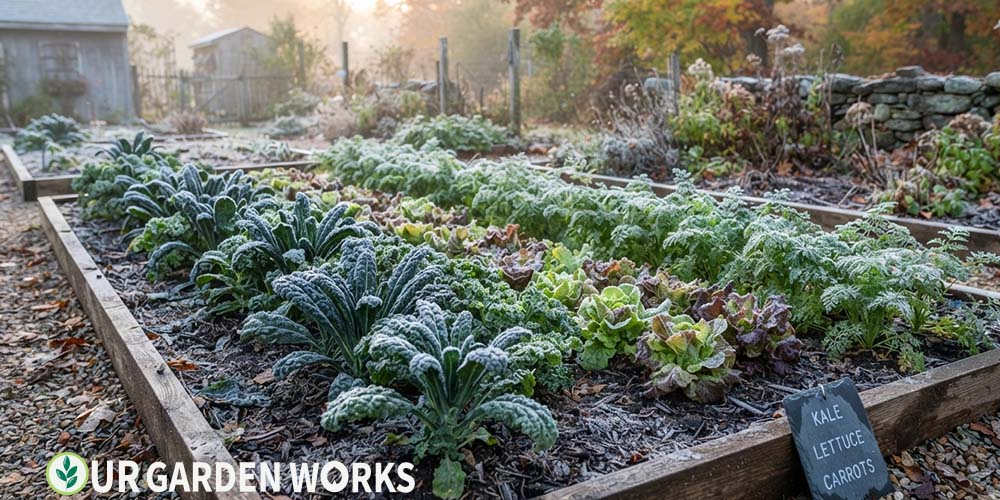
A fall garden is one of the most underused ways to extend your harvest season, and it doesn’t require starting from scratch. Most of what you need is already growing in your yard — you’re just adding a second wave of crops at the right moment.
Done right, a fall garden can keep you harvesting fresh vegetables a full two to three months beyond when most gardeners consider the season over. This guide walks through the complete planning process.
Quick Guide: Start planning in midsummer by identifying your first frost date, then count backward using each crop’s days-to-maturity plus a buffer of 10–14 days. Refresh tired soil with compost, choose cold-hardy crops, and plan for frost protection as the season progresses. Most fall gardens are planted in successive waves through August and September.
Step 1 — Know Your First Frost Date
Everything else in fall garden planning depends on this single number. Our frost dates lookup tool gives you a reliable estimate based on your ZIP code, drawing on historical weather data for your specific area.
Remember this is an average, not a guarantee — actual first frost can vary by a couple of weeks in either direction in any given year. Plan with some buffer rather than cutting it exactly to the average date.
Step 2 — Work Backward From That Date
The Math
- Find your crop’s days-to-maturity on the seed packet.
- Add 10–14 days of buffer for slower fall growth as light and temperature decrease.
- Count back from your frost date by that total number of days. This is your latest safe planting date.
- Plant earlier than this date when possible — it gives you margin if the season runs warm or you’re slightly delayed.
Our succession planting scheduler automates this math across multiple crops at once, which is genuinely useful once you’re planning more than two or three things.
Step 3 — Choose Crops That Actually Fit Your Remaining Window
This is where a lot of fall garden plans go wrong — choosing crops based on what sounds appealing rather than what your actual remaining frost-free window allows.
If you’re planning in early August with a mid-October frost date, you have roughly 70 days. That window comfortably fits kale, lettuce, spinach, radishes, and beets. It does not comfortably fit a long-season crop like winter squash started from seed at that point.
Be honest about the math before committing seeds and effort to a crop that’s unlikely to mature in time.
Step 4 — Refresh Your Soil
Soil that’s spent a full summer supporting other crops is often somewhat depleted, even with regular fertilizing. A light application of compost worked into the top few inches before fall planting gives new crops a real nutritional boost.
This matters more for fall gardens than it might seem, since the shorter growing window means there’s less time for plants to recover from a slow, nutrient-poor start.
💡 Don’t till deeply if you don’t have to
A light top-dressing of compost, gently worked into the surface, disturbs soil structure far less than deep tilling. Established soil biology (worms, beneficial fungi) recovers faster from a light refresh than a full till.
Step 5 — Plant in Waves, Not All at Once
Rather than planting your entire fall garden on a single day, stagger plantings of fast crops like radishes and lettuce every 1–2 weeks through your planting window.
This gives you a longer, more spread-out harvest rather than everything maturing simultaneously and overwhelming you all at once. It’s the same succession planting principle that works well in spring, applied to the opposite end of the season.
Why Fall Gardens Often Outperform Spring Gardens for Certain Crops
This is worth understanding, since it explains why fall planting deserves more attention than it typically gets. Many cool-season crops actually face less pest pressure in fall than in spring.
Spring populations of aphids, flea beetles, and cabbage worms build up over the season and peak in early-to-mid summer; by the time fall planting begins, several of these populations have naturally declined as their own life cycles wind down for the year.
Fall crops also benefit from cooling, rather than warming, temperatures as they mature — many greens specifically prefer this trajectory, becoming sweeter and less prone to bolting than the same crop pushed through rising spring heat.
Step 6 — Plan for Frost Protection
As your fall garden approaches its final weeks, frost protection extends the harvest meaningfully. A simple row cover or frost cloth, draped loosely over plants before a predicted frost, can protect against several degrees of cold.
For an even longer extension, a cold frame or low tunnel creates a genuinely protected microclimate that can keep hardy greens producing well into, and sometimes through, winter in moderate climates.
Watering a Fall Garden — What Changes From Summer
Watering needs shift noticeably as temperatures cool through the fall planting season. Crops need less frequent watering than the same plants would in peak summer heat, since evaporation slows considerably as days get shorter and cooler.
That said, newly seeded fall crops still need consistent moisture during germination, just like any seed at any time of year. The mistake to avoid is assuming cooler weather means watering can be largely ignored — germinating seeds and young seedlings still dry out without attention, just somewhat more slowly than in July.
Planning Your Fall Garden’s Physical Layout
Beyond timing and crop selection, a little thought toward physical layout pays off as the fall garden’s final weeks approach. Group cold-hardy crops together in one section, since they’ll likely need frost protection later as a unit rather than scattered individually throughout the bed.
Placing your most cold-sensitive fall crops (bush beans, for instance) closer to a building or wall, which retains a bit of extra warmth, can buy a few extra days of protection compared to a fully exposed spot in the open garden.
If you’re using row cover or a cold frame, plan the layout with that equipment’s dimensions in mind from the start, rather than improvising frost protection after the fact around an awkward planting arrangement.
Frequently Asked Questions
When exactly should I start planning a fall garden?
Begin thinking about it in midsummer, ideally by early July, so you have time to identify your frost date, choose crops, and prep soil before the actual fall planting window opens. Waiting until September to start planning often means missing the window for slower-maturing fall crops.
Can I start a fall garden if I've never gardened before?
Yes — in some ways fall gardens are more forgiving for beginners than spring ones, since cooler weather means less aggressive pest and disease pressure and fewer watering demands. Stick to fast, reliable crops like radishes and loose-leaf lettuce for an encouraging first fall garden experience.
Do I need to remove all my summer crops before planting a fall garden?
No — plant fall crops into whatever space opens up as individual summer plants finish, rather than waiting for an entire bed to clear at once. This keeps your garden continuously productive through the transition rather than sitting empty for weeks.
How is a fall garden different from simply planting cool-season crops in spring?
The crops themselves often overlap significantly, but the growing conditions are genuinely different — fall planting deals with warm soil cooling down and shortening days, while spring planting deals with cold soil warming up and lengthening days. This affects germination timing and growth rate even for the same exact crop and variety.
What's the biggest mistake people make starting their first fall garden?
Starting too late and choosing crops that need more time than the remaining season allows. The backward-math approach in Step 2 exists specifically to prevent this — do that calculation honestly before committing to any crop, rather than assuming there’s “probably enough time.”
Is it worth starting a fall garden in a region with mild winters where frost barely happens?
Absolutely, and in some ways even more worthwhile — mild-winter regions can often grow cool-season crops straight through winter with little or no frost protection needed at all, effectively giving you a second full growing season rather than just a few extra weeks of extended harvest.
Making Fall Gardening a Permanent Part of Your Routine
Once you’ve planned and grown one successful fall garden, the planning process described above becomes considerably faster in subsequent years — you’ll already know your frost date, have a sense of which crops performed well, and understand your own garden’s specific timing quirks.
Many gardeners who try fall planting once end up keeping it as a permanent fixture of their yearly routine, since the extra two to three months of harvest is hard to give up once you’ve experienced it firsthand.
Related Articles in Our Vegetable Gardening Guide
Free Tools
Final Thoughts
We hope this gives you a real, workable plan rather than a vague sense that fall planting is “a thing some people do.” Two to three extra months of harvest, just by planting at the right time with the right crops, is a genuinely significant return on a relatively small amount of planning.
For more on the specific crops to fill that plan with, our vegetable gardening guides cover the rest.
Share this post with a fellow gardener who thought the season was wrapping up — and let us know in the comments what’s going into your fall garden this year. Happy growing!
