

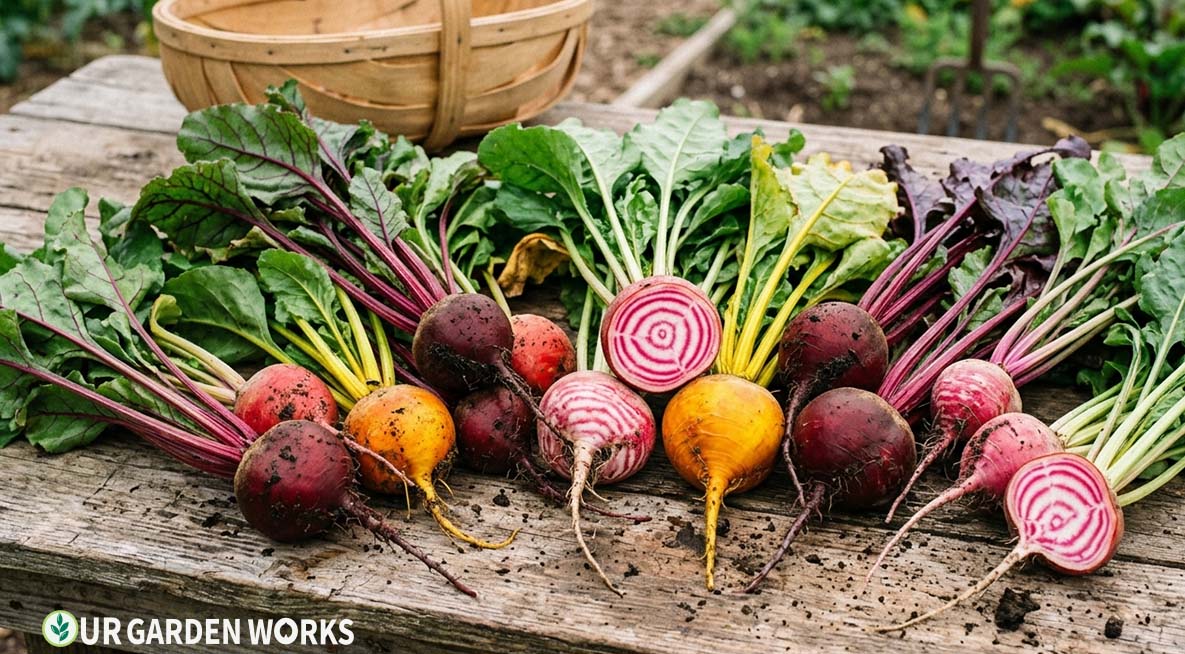
Beets are a two-for-one crop that most gardeners underutilize. You’re growing both the root you roast and the greens you sauté — and the greens are arguably the more nutritious part.
A single 4×4 bed of beets can produce two harvests simultaneously: baby roots and tender greens at 6–8 weeks, and full-sized roots at 8–12 weeks. That’s a lot of kitchen value from a small space.
The main obstacle most new beet growers hit is poor germination — and the reason is almost always the “seed” itself. What looks like a single beet seed is actually a dried fruit containing 2–4 true seeds clustered together. Even with perfect sowing technique, you’ll get multiple seedlings per spot that must be thinned. Understanding this is half the battle.
How to Grow Beets: Sow beet seeds ½ inch deep in cool soil (50–65°F), 1 inch apart. Soak seeds overnight before planting for better germination. Each “seed” produces 2–4 seedlings — thin ruthlessly to 3–4 inches apart. Direct sow spring and fall crops; beets bolt in summer heat. Harvest at 1.5–3 inches diameter for best flavor.
Why Beets Deserve More Garden Space Than They Usually Get
Beets get treated as an afterthought crop in a lot of vegetable gardens, tucked into a corner bed almost as an experiment. That’s a missed opportunity, because few crops give back as much per square foot.
Within the same growing window as a single planting of lettuce, a beet bed delivers a continuous harvest of greens you can cut repeatedly, plus a root crop that stores for months in the right conditions — something almost no leafy green can offer.
Beets are also remarkably tolerant of less-than-ideal soil compared to their root vegetable cousins.
Carrots demand deep, stone-free soil to grow straight; beets are far more forgiving, producing a respectable harvest even in moderately compacted or rocky beds, since the root itself is rounder and shorter and doesn’t need to push as deep to reach full size.
That makes beets an excellent choice for a gardener still working on improving native soil, or for a new raised bed in its first season before the mix has fully settled.
Choosing Your Beet Variety
| Variety | Color | Days | Notes |
|---|---|---|---|
| Detroit Dark Red | Deep red | 58–65 | Classic; reliable; best greens of any variety |
| Chioggia | Candy-striped (red/white) | 55 | Heirloom; beautiful when sliced; milder flavor; fast |
| Golden | Golden yellow | 55–60 | Sweetest flavor; doesn’t bleed; best for salads and roasting |
| Cylindra | Dark red, cylindrical | 60 | Produces uniform slices; great for pickling; space-efficient |
Planting Detroit Dark Red alongside Chioggia and Golden in the same bed gives you a stunning harvest with flavor variety. The seed costs are minimal. This is one of the easiest ways to make your garden look impressive with almost no extra effort.
Soil and Site Preparation
Beets prefer loose, well-draining soil rich in organic matter, with a pH between 6.0 and 7.5 — slightly more tolerant of alkaline conditions than most root vegetables. Work 2–3 inches of finished compost into the top 8–10 inches of soil before sowing.
Unlike carrots, beets don’t require an extreme depth of perfectly loosened soil, but removing larger rocks and breaking up dense clumps in the top several inches still measurably improves root shape.
One detail that catches new growers off guard: beets are sensitive to boron deficiency, which shows up as black, corky spots inside the root — invisible until you slice one open.
If your soil has a known boron deficiency (common in some sandy or heavily leached soils), a light application of borax dissolved in water, applied once during the growing season at a very small rate, can prevent this. For most home gardens with reasonably balanced soil, this is rarely an issue worth pre-treating for.
How to Grow Beets: Step by Step
Step 1 — Sow in Cool Weather
Beets are cool-season crops that perform best in soil temperatures of 50–65°F. They germinate poorly above 75°F and bolt in sustained heat. Direct sow spring crops 4–6 weeks before last frost, and fall crops 6–8 weeks before first frost.
Directions
- Pre-soak seeds overnight in warm water. This dramatically improves germination by softening the tough seed coating. Expect 20–30% faster germination and meaningfully better germination rates.
- Sow ½ inch deep, 1 inch apart, in rows 12 inches apart or broadcast in a broad bed.
- Keep soil consistently moist until germination — 7–14 days. In warm soil, 5–7 days.
- When seedlings are 3 inches tall, thin to 3–4 inches between plants. This is non-negotiable — crowded beets produce small, forked roots. Eat the thinnings as baby greens.
Step 2 — Watering and Feeding Through the Season
Beets need about 1 inch of water per week, applied consistently rather than in occasional heavy soakings.
Like many root crops, beets respond to alternating wet and dry periods by producing roots that split or develop a woody, fibrous texture, so a regular watering rhythm pays off more in flavor and texture than it does in sheer yield.
Feed lightly. A single application of balanced fertilizer worked in at planting, plus a light side-dressing of compost around 4 weeks in, is typically all a beet bed needs.
Resist the urge to add extra nitrogen mid-season — like carrots, beets respond to excess nitrogen with lush, oversized greens at the expense of root development, which is the opposite of what most gardeners are growing beets for.
Try our free tool: Garden Watering Calculator — How Much Water Your Crops Need
Step 3 — Harvesting Both Greens and Roots
Greens harvest: Begin taking 1–2 leaves per plant once plants are 6 inches tall. Never take more than 30% of the foliage from any plant — the leaves are powering root development. Young beet greens are mild and tender; older ones become slightly bitter but still excellent cooked like Swiss chard.
Root harvest: Harvest baby beets at 1–1.5 inches for maximum tenderness. Full-sized beets at 1.5–3 inches diameter have the best flavor balance. Beyond 3 inches, beets become woody and strongly flavored. Gently brush away soil to check size — the shoulder of the beet is usually visible above the soil surface.
Unlike many garden vegetables, mature beets store for 3–5 months in a cool, humid environment like a root cellar or the crisper drawer of a refrigerator, especially if you trim the greens off (leaving an inch of stem) and leave a little soil clinging to the root rather than washing it clean before storage.
This makes a fall beet crop one of the better candidates for genuinely extending your harvest through winter without any canning or freezing involved.
Frequently Asked Questions
Why are my beets small and forked?
Inconsistent thinning (too crowded), rocks or compaction in the soil, or insufficient watering during root development. Beets need the same loose, rock-free soil as carrots for proper root formation. Thin to 3–4 inches — this is the most commonly skipped step.
Can I grow beets in containers?
Yes — use containers at least 12 inches deep. Cylindra variety (cylindrical shape) works particularly well in containers. Baby beet varieties like Merlin also work well with shallower root development than standard types.
Why do beets turn the cooking water red?
The deep red color comes from betalain pigments — potent antioxidants that leach into water when heated. Roasting beets in their skins retains most of the color and nutrients. Golden beets don’t bleed and are often preferred for dishes where you don’t want everything stained red.
What are the black spots inside some of my beets?
This is internal black spot, usually caused by a boron deficiency in the soil rather than a disease or pest. The roots are still safe to eat — simply cut away the affected tissue. If it’s a recurring issue across your beet harvests, a soil test will confirm boron levels, and a very light boron supplement worked into the bed before the next planting usually resolves it.
Can I plant beets twice in the same season?
Yes — beets are well suited to succession planting. Sow a spring crop 4–6 weeks before last frost, then a second sowing in midsummer timed 6–8 weeks before your first fall frost.
Avoid sowing through the hottest stretch of summer, since high soil temperatures both slow germination and push mature plants toward bolting rather than root development.
🥬 Related Articles in Our Vegetable Gardening Guide
Final Thoughts
We hope this guide has shown you why beets deserve a permanent spot in your vegetable rotation — two crops in one plant, cold-hardy, and beautiful at harvest. For all our vegetable growing guides, our vegetable gardening guide links to everything.
Share this post with a fellow gardener who’s ready to grow their own — and let us know in the comments which variety combination you’re planting — the mixed planting is always worth it. Happy growing!
