

Here’s the honest truth about carrots: most gardeners who struggle with them are fighting their soil, not the plant.
Forked, stubby, or twisted carrots are almost always a soil problem — compaction, rocks, or clumps that the growing root has to navigate around. Get the soil right and carrots are one of the most rewarding and beautiful crops in the vegetable garden.
The payoff is real. Homegrown carrots — especially left in cold soil for a few weeks after frost — develop a sweetness that grocery store carrots never achieve. Cold temperatures convert starches in the root to sugars, and no commercial grower waits for that to happen. You can.
How to Grow Carrots (Quick guide): Direct sow carrot seeds ¼ inch deep in loose, rock-free soil from early spring through midsummer. Thin ruthlessly to 3–4 inches apart — crowded carrots stay small. Keep soil consistently moist during germination (10–21 days). Harvest at 60–80 days. Leave in ground through early frost for maximum sweetness.
Choosing Your Carrot Variety
| Type | Best Varieties | Length | Best For |
|---|---|---|---|
| Nantes | Scarlet Nantes, Touchon, Nelson | 6–7 inches | Best flavor; cylindrical, blunt-tipped; easiest to grow in less-than-perfect soil |
| Chantenay | Red-Cored Chantenay, Hercules | 4–5 inches | Heavy clay soils; short and broad; stores very well |
| Imperator | Tendersweet, Apache | 8–10 inches | Deep, loose soil only; the classic long grocery-store shape |
| Danvers | Danvers 126, Danvers Half Long | 6–8 inches | Adaptable, drought-tolerant, good for clay |
| Baby / mini | Thumbelina, Paris Market, Little Fingers | 2–4 inches | Containers, heavy soils, fastest harvest |
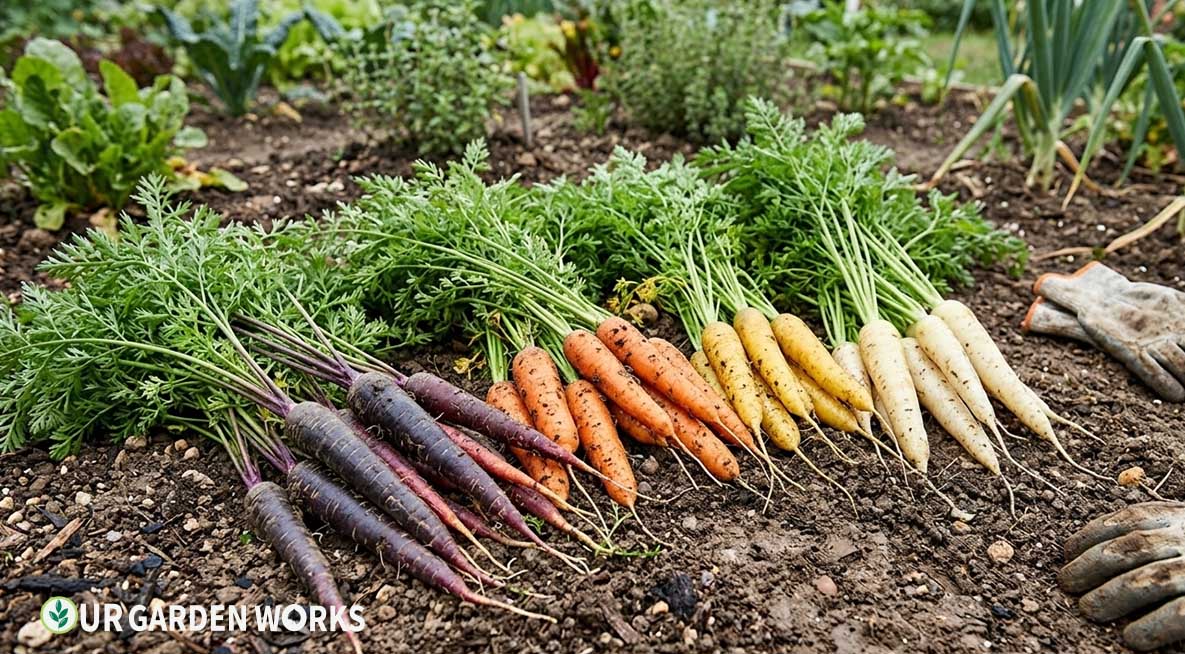
| Colored varieties | Purple Haze, Cosmic Purple, Solar Yellow | Various | Visual appeal; same care as Nantes types |
Nantes types are the most forgiving — their blunt, shorter shape tolerates less-than-perfect soil better than long Imperator types. Scarlet Nantes is the classic first choice. If your soil is heavy clay, start with Chantenay or Thumbelina and improve your soil in parallel.
The Soil Preparation That Prevents Forking
This is where we spend the most time — because it’s the make-or-break step for straight, full-sized carrots.
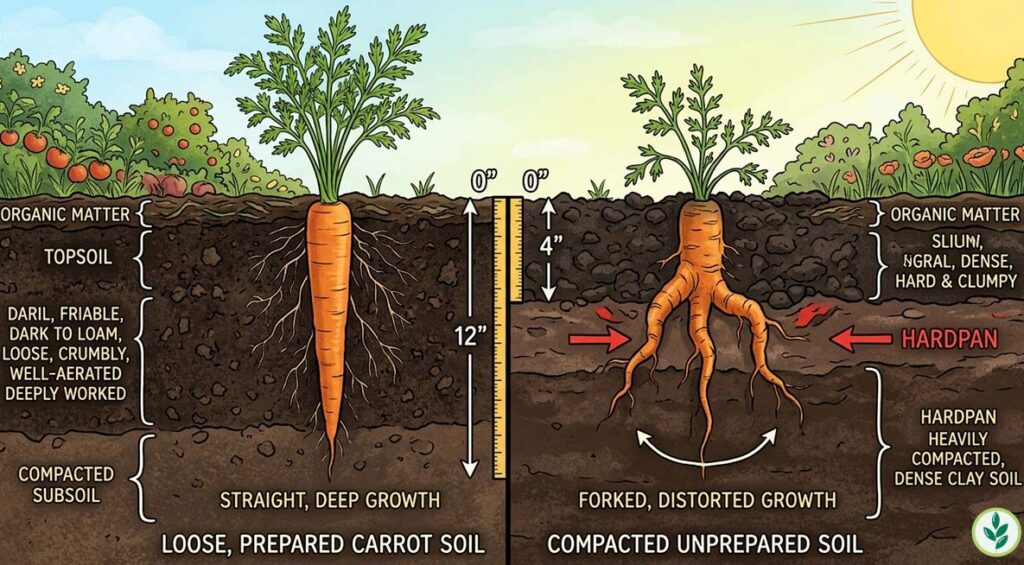
Carrot roots grow downward under the pressure of their own cell expansion. Any obstacle — a rock, a clump, a patch of compaction — causes the root to split, fork, or twist around it. The solution isn’t avoiding obstacles; it’s eliminating them entirely from the top 12 inches of soil.
How to Prepare Carrot Soil
- Work the soil to 12–15 inches deep. This is non-negotiable for Nantes and Imperator types. A garden fork is better than a tiller for this — fork loosens without destroying soil structure.
- Remove every stone, root fragment, and clump you can find. Run your hands through the loosened soil. Carrots will fork around anything larger than a marble.
- Mix in compost — but not fresh compost with chunks. Finely aged compost or leaf mold blended evenly through the profile. Chunks cause forking just like rocks do.
- Do not add fresh manure or heavy nitrogen fertilizer. High nitrogen produces beautiful feathery tops and forked, hairy, bitter roots. Phosphorus and potassium are what carrots need — use a fertilizer heavy on the latter two (5-10-10).
- For clay soil: raise the bed and mix in 30–40% coarse sand or perlite by volume through the carrot-growing depth. This is more work but completely changes your results.
Sowing, Thinning, and Germination
Sowing
Carrot seeds are tiny and should be sown as thinly as possible. Oversowing is the most common beginner mistake — it means more thinning later and higher competition for the plants that remain.
Directions
- Sow seeds ¼ inch deep in rows or broad beds. In rows: make a shallow furrow with your finger or a trowel handle.
- Sow seeds 1 inch apart — or mix seeds with fine sand (4:1 sand to seed) for more even distribution.
- Cover lightly and firm down gently — seed-to-soil contact is essential for germination.
- Water gently with a fine spray. Carrot seeds wash away easily — use the gentlest setting on your nozzle.
- Cover with a board or burlap until germination to retain moisture. Check daily and remove immediately when sprouts emerge.
Germination — The Patience Phase
Carrot germination takes 10–21 days depending on soil temperature. In cool soil (50°F), expect 3 weeks. In warm soil (70°F), expect 10–14 days.
The soil must stay consistently moist throughout this entire period — the most common cause of poor germination is the surface drying out even once during this window. Check daily and water lightly if the top ½ inch dries out.
Thinning — The Step You Can’t Skip
Thinning is not optional. Carrots need 3–4 inches of space to develop full-sized roots — crowded plants produce small, twisted carrots that compete for nutrients and space.
Thin in two stages: first when seedlings are 1 inch tall (thin to 1 inch apart), then again at 3 inches tall (thin to 3–4 inches apart). Use the thinnings as baby carrots in salads — they’re delicious at this stage.
Watering and Feeding Through the Season
Watering: 1 inch per week, deep and consistent. Irregular watering causes splitting, especially if a dry period is followed by heavy rain or irrigation. The carrot absorbs water rapidly and the internal pressure cracks the root. Drip irrigation or soaker hoses are ideal.
Mulch: 2 inches of straw or shredded leaves helps maintain consistent soil moisture and prevents the green shoulders (from sunlight exposure to the top of the root) that make carrots bitter at the crown end.
Feeding: One light application of 5-10-10 fertilizer at 4–6 weeks after germination. Don’t over-feed. Carrots in well-amended soil often need no supplemental fertilizer at all.
When to Harvest — Wait for Frost for Sweetest Flavor
Most carrot varieties are ready in 60–80 days from sowing. Check by gently brushing soil away from the top of the root — the shoulder should be at least ½ inch in diameter for Nantes types. Pull one carrot and taste it. That’s the most reliable harvest signal.
The secret to the sweetest carrots: leave them in the ground through one or two light frosts. Cold temperatures trigger the plant to convert stored starches to sugars — a process called cold-sweetening.
Frost-kissed garden carrots have a flavor that no grocery carrot can match. In Zone 6 and warmer, you can leave carrots in the ground all winter under a heavy mulch and harvest them as needed.
If you’re growing a fall crop specifically for storage rather than fresh eating, it’s worth resisting the temptation to harvest everything at once after the first frost.
Carrots left in the ground under a thick layer of mulch continue to slowly sweeten through the following weeks, and pulling them as needed through late fall and into early winter often produces better flavor than harvesting the whole bed in one go and storing the roots indoors.
Frequently Asked Questions
Why are my carrots forked or stunted?
Almost always a soil issue — compaction, rocks, fresh compost chunks, or not enough depth. See the soil preparation section above. Address this before replanting. No amount of good care produces straight carrots in compacted or rocky soil.
Can I grow carrots in containers?
Yes, with deep containers (at least 12 inches) and baby or Chantenay varieties. Use a loose, stone-free potting mix with added perlite. See our grow carrots indoors guide for container specifics.
What are the feathery white roots on my carrots?
These are secondary root hairs, usually triggered by inconsistent watering or high nitrogen in the soil. Reduce nitrogen and keep moisture consistent. The carrot is still edible — trim the hairs and eat normally.
Can I direct sow carrots in summer for a fall harvest?
Yes — this is one of the best strategies. Sow 10–12 weeks before your first expected frost. Fall carrots often develop better color and flavor than spring ones because cooling temperatures concentrate sugars during the final weeks of development.
How is growing carrots different from growing beets, since they're often planted together?
Carrots are considerably more demanding about soil preparation — they need deep, stone-free soil to grow straight, while beets tolerate moderately compacted or rocky soil reasonably well since their roots are shorter and rounder.
Both share similar watering and thinning needs, which is why they’re commonly grown side by side, but if you’re working with heavy clay or a new bed that hasn’t been deeply amended yet, beets will generally reward you with a better harvest than carrots will in that same soil.
🥬 Related Articles in Our Vegetable Gardening Guide
- How To Grow Carrots Indoors – An Easy Guide To Follow
- What Do Carrot Sprouts Look Like & How To Identify Them?
- How To Preserve Carrots & Extend Their Shelf Life
- What to Plant with Garlic – Best and Worst Companion Plants
- How to Grow Beets: Roots and Greens in One Plant (2026)
- Vegetable Gardening Guide
Final Thoughts
We hope this guide has cracked the carrot code for you — because once you get the soil preparation right, everything else falls into place.
The frost-sweetening technique alone will change how you think about harvest timing. For all our vegetable growing guides in one place, our vegetable gardening guide has them all.
Share this post with a fellow gardener who’s ready to grow their own — and let us know in the comments which carrot variety you’re growing and what your soil situation looks like. Happy growing!
